

Beginner: name every asset and recipient
Do not start with a generic NDA request. Identify what will be shared, who owns it, which legal entity receives it, why that recipient needs it and what must remain withheld.

IP protection in China is a sequence of rights, disclosure, contract, access, and evidence decisions. Identify the asset, territory, legal counterparty, permitted use, owner, and approval gate before sharing sensitive files. A contract label does not create registered rights, and a filing does not replace access control or proof.
Map trademarks, patents, trade secrets, contracts, tooling ownership, disclosure controls, and China Customs options before sharing...
List every brand name, logo, drawing, CAD file, artwork file, firmware build, source file, formula, test method, mold, fixture...
Inventory the assets. The buyer names each brand, design, file, method, tool, account, and confidential data set, then records its...
This guide is for importers, procurement teams, ecommerce sellers, small businesses, private-label brands, and product developers...
Use IP Protection in China as the topic: each level depends on the record discipline established before it. Complete the beginner controls before relying on the advanced ones.
Do not start with a generic NDA request. Identify what will be shared, who owns it, which legal entity receives it, why that recipient needs it and what must remain withheld.
Coordinate counsel-directed searches, filings and agreements with redacted quotation packs, named recipients, controlled revisions, prototype gates, tooling schedules and a disclosure log.
Monitor new factories, subcontractors, repositories, staff access, product revisions and suspected misuse. Preserve evidence and route legal, administrative, platform or Customs decisions to the rights holder and qualified counsel.
List every brand name, logo, drawing, CAD file, artwork file, firmware build, source file, formula, test method, mold, fixture, supplier list, and packaging element that may be shared. For each item, record the owner, version, sensitivity, intended recipient, permitted use, required right or contract review, and the event that authorises disclosure.
Record where the product will be manufactured, sold, shipped, and enforced; who currently owns each right; which searches or filings exist; and which questions require qualified China IP counsel before disclosure.
Verify the legal supplier, manufacturing site, affiliates, subcontractors, engineers, systems, and repositories that may receive access. Set permitted recipients, file permissions, handover conditions, and a dated disclosure log.
This guide is for importers, procurement teams, ecommerce sellers, small businesses, private-label brands, and product developers preparing to share commercially sensitive material with a supplier or design partner in China. Use it before a supplier search, quotation, prototype, tooling order, software handoff, packaging release, factory change, or suspected misuse.
It means matching each asset to the right legal and operational control before disclosure. A trademark, patent or design filing, copyright record, trade-secret measure, supplier agreement, tooling schedule, access permission, and evidence log solve different problems. None is a universal shield, and protection held in another country does not automatically decide rights in China.
Filing priority is important for trademarks, but the current law, earlier rights, bad-faith provisions, classes, goods or services, use, evidence, and available procedures all matter. China amended its Trademark Law on 26 June 2026; WIPO lists the current Chinese text but does not yet provide the current English text. Buyers should not treat an older English summary as the final rule for a live filing or dispute.
Sometimes, but supplier splitting is an information-architecture decision rather than a default protection method. Giving one factory only the component or process it needs can reduce complete-product visibility. It can also add file transfers, subcontractors, interfaces, quality variation, logistics work, and more potential leakage points. Compare a single controlled supplier, compartmentalised suppliers, a trusted integrator, and buyer-held final assembly against the same disclosure, coordination, cost, quality, and recovery criteria.
Do not reduce NNN versus NDA in China manufacturing to a form-label contest. Before sensitive product designs are shared, qualified counsel should confirm the verified parties, language, permitted use, recipients, onward disclosure, confidentiality, non-use or non-circumvention terms where appropriate, governing law, forum, remedies, return or destruction duties and signatures. The buyer should then release only the files needed for the approved stage and log the recipient and revision.
Contracts and access controls do not create registered trademark, patent or design rights. Counsel should separately assess searches, ownership, novelty or filing timing, goods and service classes, territories and the appropriate national or international route. CNIPA states that a foreign company without a business domicile in China must use a lawfully established trademark agency for the domestic route. The Madrid System begins through the applicant's Office of origin, and the designated office applies its own law. If suspected misuse occurs, preserve dated source files, agreements, disclosure logs, samples, correspondence and screenshots before the rights holder and counsel choose an administrative, judicial, platform or China Customs response.
The answer should be written asset by asset. Record the pre-existing owner, new deliverable, assignment or licence, permitted use, territory, term, modification right, derivative work, subcontractor access, repository account, source-file handover, tooling possession, maintenance, transfer, and end-of-project obligations. Payment for development or tooling does not by itself prove that every intellectual property right, physical asset, or file has transferred.
Use named gates for quotation disclosure, engineering files, prototype build, tooling release, sample approval, production revision, component or firmware change, artwork release, subcontractor access, and final file handover. Each approval should identify the asset, revision, evidence reviewed, open exceptions, approver, date, and permitted next use. A sample approval should not silently authorise supplier ownership, resale, unauthorised production, or reuse of tooling.
Possible cost factors include professional searches, filing and official fees, local agents, counsel, translation, record preparation, agreement drafting, technical drawings, access-control systems, tooling identification, monitoring, test purchases, evidence preservation, Customs recordation, platform complaints, and enforcement. The applicable items and amounts depend on the assets, territories, rights, urgency, and response route; this guide does not provide a legal-fee estimate.
LifaSourcing.com can coordinate supplier identity records, staged information requests, document circulation, disclosure logs, tooling identifiers, sample revisions, change requests, and China-side follow-up through factory verification and OEM and ODM sourcing. The buyer remains the decision owner. Legal advice, rights searches, filings, agreement drafting, validity, infringement analysis, Customs applications, and enforcement belong with qualified counsel, official authorities, and the rights holder.
The documents needed include an asset register, territory and rights brief, official search or filing records, verified counterparty list, counsel-approved agreement, signed copies, disclosure log, access register, ownership schedule, prototype and tooling approvals, change log, monitoring plan, and incident evidence file. Use the IP protection decision template (CSV) to assign owners, dates, gaps, and next steps. It is an operational record, not a legal opinion or proof that a right exists.
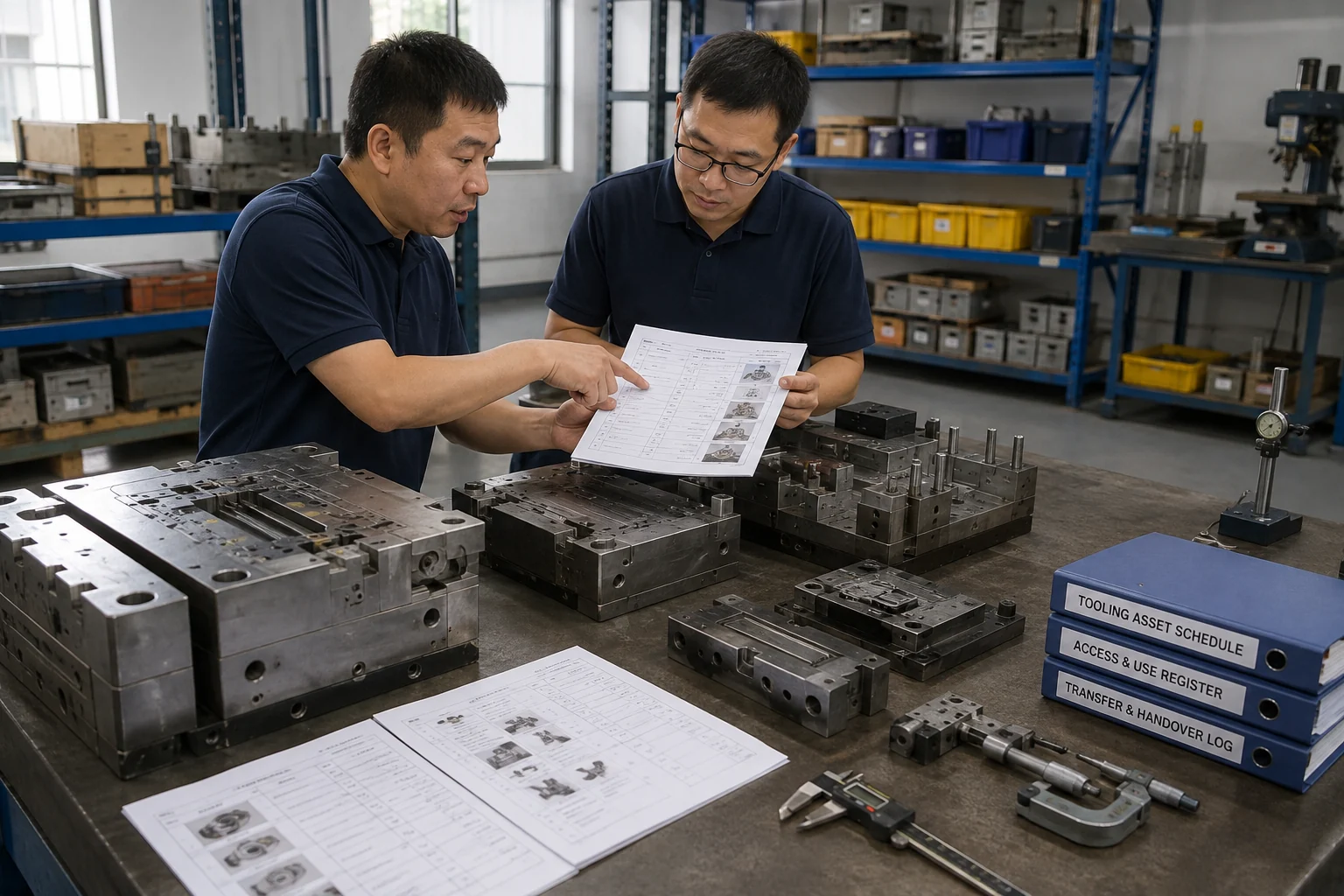
Identify the tool, payer, legal owner, physical holder, authorised users, permitted products, maintenance duty, transfer conditions, and end-of-project handover.
Photograph and identify each mold, insert, fixture, gauge, programming device, drawing, and source file by revision.
State ownership, possession, permitted use, subcontractor access, storage, maintenance, reproduction, and modification rights.
Define the event, documents, condition, cost, location, and authorised recipient for transfer, return, export, or disposal.
Continue through tooling, contracts, and supplier red flags.
The full detail on mold ownership and custom tooling agreements.
Read the guide 06Where an NNN clause fits into the broader manufacturing agreement.
Read the guide 07Warning signs that can signal a higher IP risk.
Read the guide 08How the manufacturing model affects IP exposure.
Read the guideCLIENT REVIEWS
Feedback shared by clients.
I had a folder full of attractive product photos and no sensible way to choose a supplier. LIFA narrowed the search to businesses that could handle our finish and order size, then explained why the others had been left out. The shortlist was shorter than I expected. That turned out to be the useful part; I could spend time on relevant conversations instead of starting from scratch with everyone.
The first call felt rather detailed for a simple tote bag enquiry. Once we discussed carrying weight, handle length and how the bags would be packed, I understood the questions. I did have to repeat our delivery address in a later email, which was mildly frustrating, but the final brief captured the things my original message had missed.
A supplier described itself as the manufacturer, although the paperwork suggested otherwise. Our contact at LIFA separated the trading company from the production site in the supplier notes. There was no dramatic claim that the business was dishonest. We just needed to understand who would make the goods and who would be taking our payment.
Most responses to our furniture enquiry focused on appearance. LIFA noticed the assembly restriction for our delivery team and asked suppliers about it before requesting prices. We would have rejected several lovely-looking options once the cartons arrived. Catching that early was more valuable to me than another page of designs.
Six boundaries to settle with current official records and qualified counsel before disclosure or enforcement.
Do not assume that it does. Trademark rights are territorial, and a China strategy may involve a national application or an international route that designates China. Ask qualified counsel to review the mark, owner, classes, goods or services, searches, priority, current law, and filing timing.
No. Filing priority is important for trademarks, but earlier rights, bad-faith provisions, classes, goods or services, use, and procedure can matter. Patents, designs, copyright, and trade secrets have different requirements. Check the current law and facts with qualified counsel.
Use a document prepared or approved by qualified counsel for the verified parties and intended transaction. It should address permitted use, recipients, onward disclosure, confidentiality, non-use or circumvention concerns where relevant, language, governing law, forum, remedies, return or destruction, and signatures. The label NDA or NNN is not enough.
The parties should define this asset by asset in a counsel-reviewed agreement. State pre-existing ownership, new deliverables, assignment or licence, permitted use, modification, subcontractor access, source-file handover, physical possession, maintenance, transfer, and end-of-project duties. Payment alone does not settle every right.
It can reduce how much one supplier sees, but it also creates more transfers, interfaces, subcontractors, and coordination points. Compare compartmentalisation with a controlled single supplier, trusted integrator, or buyer-held final assembly, and document who receives each file or component.
China Customs provides an IPR protection and recordation route for qualifying rights connected to import or export goods. Applications, supporting rights records, product information, security, evidence, and response deadlines may apply. The rights holder should confirm the current procedure with China Customs and qualified counsel.

Release information by stage only after the recipient, permitted use, agreement, file revision, access route, and buyer approval have been recorded.
Share a redacted functional brief where possible; withhold unnecessary CAD, source files, supplier data, and production know-how.
Verify the legal party, complete counsel-directed agreements, name recipients, and record every controlled file and revision released.
Approve ownership schedules, tooling release, subcontractor access, golden sample, change control, repository permissions, and handover terms.
IP protection lives in contracts, tooling ownership, and how much you disclose to whom.
This sequence turns IP Protection in China into a reviewable sourcing record. Adapt the depth to the product, order, market, and risk while keeping the decision trail intact.
Name each mark, design, drawing, source file, formula, firmware build, account, mold and production method. Record its claimed owner, version, sensitivity, commercial use and known public disclosure.
Give qualified counsel the manufacturing, sales and transit countries, planned launch, existing rights and prior disclosures. Record which searches, filings or ownership questions must be resolved before release.
Confirm the supplier legal entity, factory, affiliates, subcontractors, engineers, repositories and devices that may receive files. Do not assume the sales contact and manufacturing party are the same entity.
Use counsel-approved documents for the actual parties and transaction. Start with a redacted functional brief where possible, then release only the information required for quotation, prototyping, tooling or production.
Identify the approved revision, permitted use, golden sample, tooling owner, physical holder, subcontractor access and written change authority before the next commitment.
Keep signed agreements, official search or filing records, disclosure logs, source files, access records, approvals, samples, tooling photographs, correspondence and exceptions under consistent names and dates.
Stop the next disclosure when identity, ownership, filing advice, permissions or evidence is unresolved. If suspected misuse appears, preserve evidence first and let the rights holder and qualified counsel select the response route.
Use this IP Protection in China table as a working rule. It does not replace current legal, customs, testing, financial, or technical advice for the exact transaction.
| Control route | Use it when | Minimum record | Stop condition |
|---|---|---|---|
| Redacted or staged disclosure | The supplier can quote or assess feasibility without the complete technical package. | Asset list, redacted brief, named recipient, permitted purpose, file version and approval. | The recipient requests unrelated source files, supplier lists or complete CAD before scope and identity are verified. |
| Counsel-reviewed agreement and controlled access | A verified party needs confidential information for prototyping, tooling or production. | Signed agreement for the actual parties, access list, disclosure log, repository permissions and return or destruction terms. | The legal party, applicable language, permitted use, subcontractor access, signatures or approval owner is unresolved. |
| Rights, Customs or enforcement review | A filing decision, protected design, live infringement concern or import/export control is involved. | Current official records, ownership chain, dated source evidence and a qualified adviser or authority route. | The buyer is relying on an old summary, an unverified right, incomplete evidence or a generic contract template as a legal conclusion. |
Use IP Protection in China to frame the matched case decision without adding claims or outcomes beyond its source classification.
A buyer has verified one supplier for a custom enclosure, but the proposed subcontractor and shared file repository are still unknown. The buyer releases the external dimensions and performance requirements for quotation, withholds the internal CAD and source files, and records the unresolved recipients as a stop before prototype tooling.
Escalate before disclosure when ownership is disputed, a filing or validity question affects launch, source code or high-value tooling is involved, the counterparty is unclear, or suspected misuse may require urgent evidence preservation.
Name the event that permits each release: verified entity, counsel-approved agreement, filing instruction, prototype approval, tooling schedule, golden sample or written change authority.
Send searches, filings, ownership, validity, infringement, governing law, Customs recordation and enforcement choices to qualified counsel, official authorities and the rights holder.
Keep original source files, hashes or version records where used, agreements, disclosures, access logs, samples, correspondence, screenshots, purchase records, approvals and review dates under a controlled retention policy.
This guide was reviewed on 2 September 2026. WIPO lists China's Trademark Law as amended through 26 June 2026 and notes that its current English text is unavailable there. CNIPA, WIPO and China Customs procedures can change, so confirm the current route, language, evidence, deadlines and applicant requirements for the exact right and facts before relying on them.
Primary reference: WIPO Lex, Trademark Law of the People's Republic of China
Assign each asset, rights question, counterparty, agreement, disclosure, ownership term, approval gate, and open gap to a named owner. Send legal questions to qualified counsel before the next release.
Use current official records for filing and Customs procedures. A source page does not decide ownership, validity, infringement, jurisdiction, or the best response for a live dispute.
Independent service-review context: view the public LifaSourcing.com Trustpilot profile. Reviews do not validate legal advice, a filing, an agreement, ownership, infringement, Customs action or an enforcement result.
Reviewed 2 September 2026 by the LifaSourcing.com editorial team. Recheck this page when China changes an IP law, official procedure, filing route, Customs service or authoritative translation. Obtain qualified legal advice before filing, contracting, alleging infringement or starting enforcement.Settle these practical questions before applying an IP protection plan to a live supplier, design release, tooling order, contract, filing, or enforcement decision.
Keep the asset register, rights and territory brief, official search or filing records, verified counterparty list, counsel-approved agreement, disclosure log, access record, ownership schedule, prototype and tooling approvals, change log, incident evidence, and dated buyer decisions together. Each record proves only what it directly documents; none alone proves enforceability or infringement.
A hypothetical private-label pet accessory uses a new brand, packaging artwork, CAD drawings, and a custom mold. Before sending full files, the buyer inventories each asset, asks counsel about China trademark and design options, verifies the supplier entity, approves the agreement and disclosure sequence, and shares a redacted quotation pack. Full CAD is released only for the approved prototype stage. The example demonstrates control points; it does not establish that any right is registrable, valid, or infringed.
This guide is an operational sourcing framework, not legal advice. LifaSourcing.com can coordinate supplier records, controlled document exchange, tooling identifiers, sample revisions, and follow-up. It does not perform legal searches, file rights, draft legal instruments, determine ownership or infringement, represent a rights holder, or guarantee an enforcement result.
Compare the asset covered, territory, timing, disclosure prevented, rights or contract basis, responsible owner, evidence produced, renewal or monitoring need, response route, and professional cost factors. Stop when the legal entity is unverified, advice is outdated, sensitive files have no access plan, or the buyer cannot identify who approves the next disclosure.