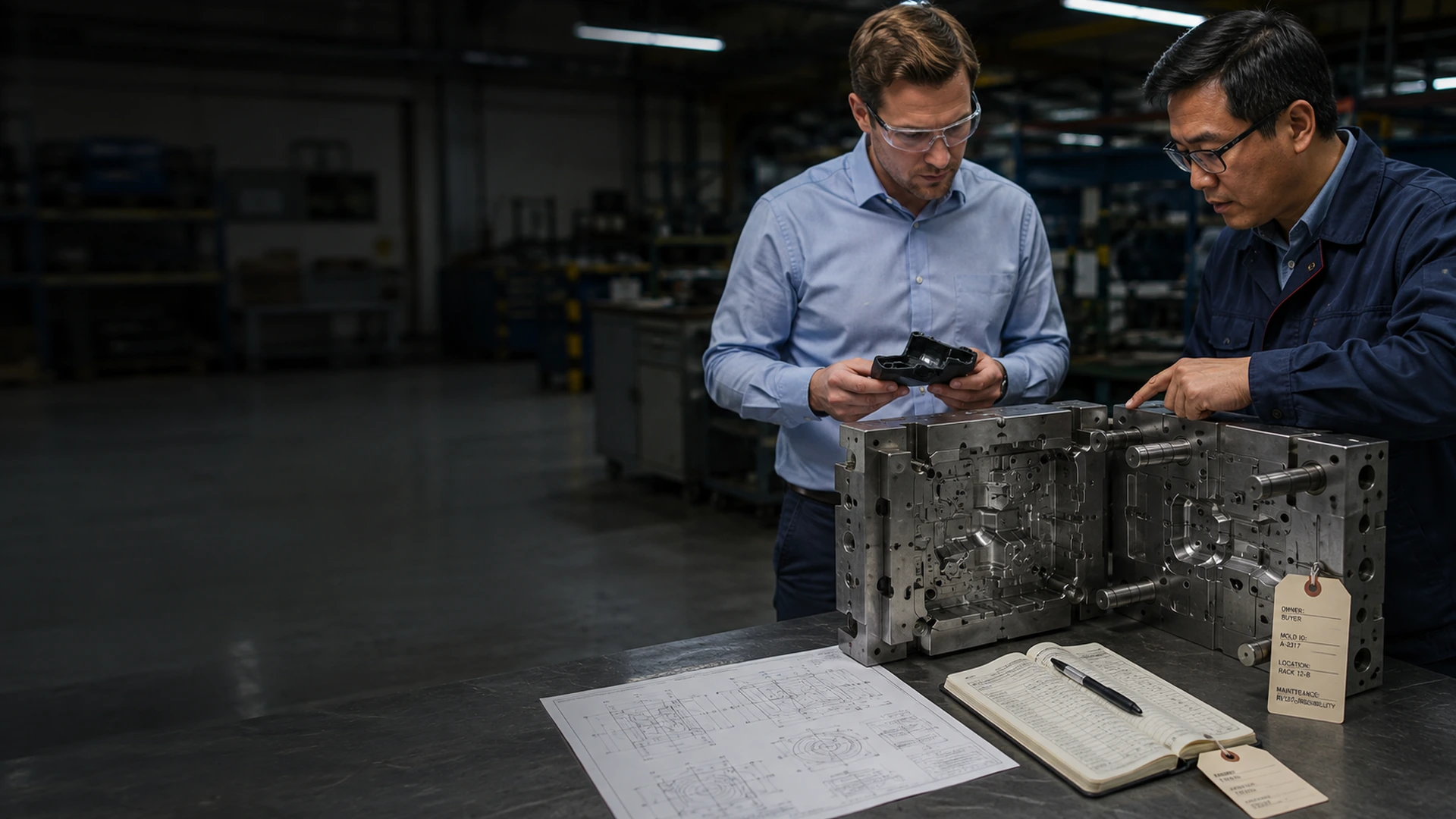
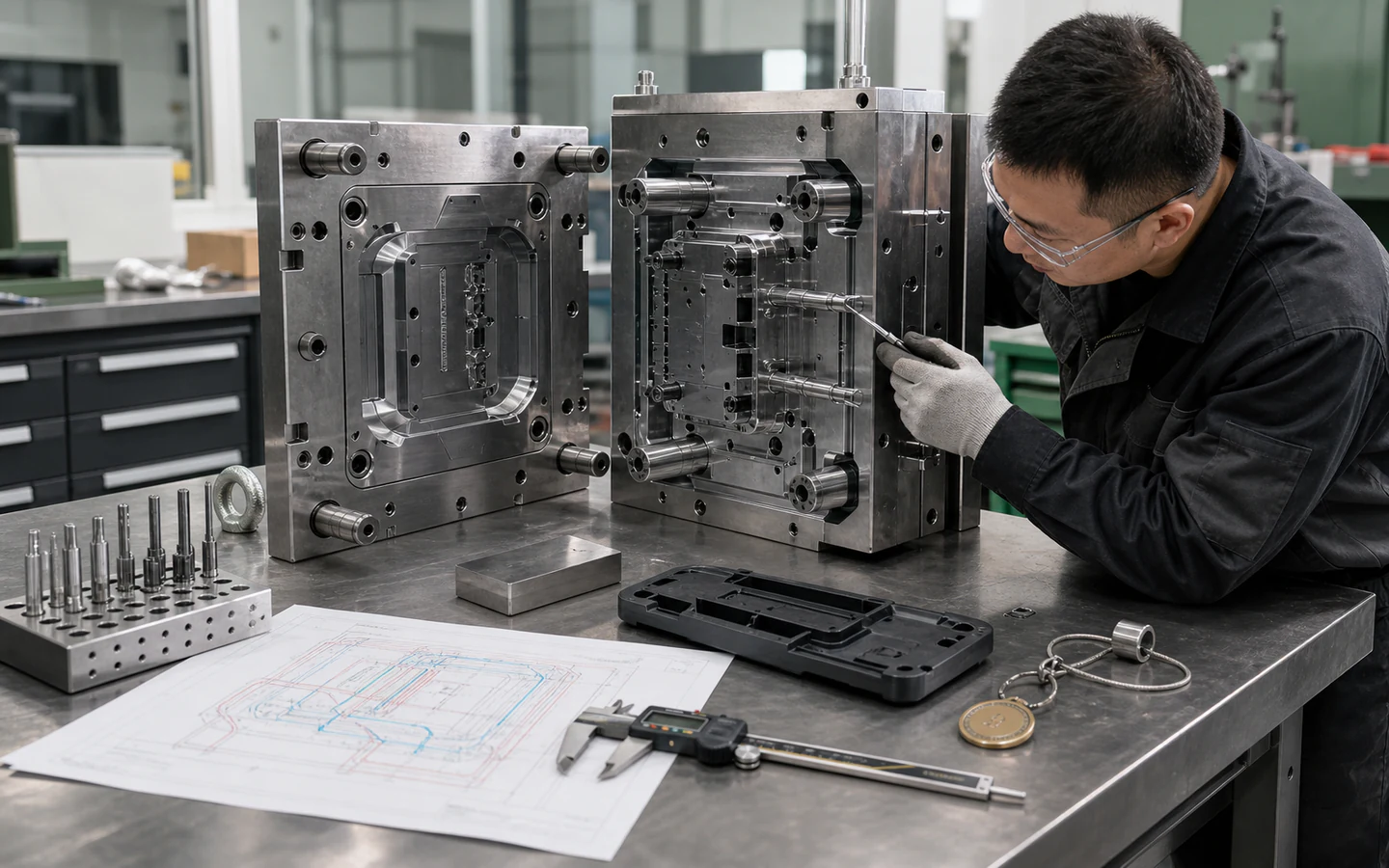
Injection mold tooling review with custom mold components, product samples, and manufacturing specifications Injection mold tooling review with custom mold components, product samples, and manufacturing specifications alternate workspace scene Injection mold tooling review with custom mold components, product samples, and manufacturing specifications detailed sourcing coordination scene
Manufacturing · Guide 01

Tooling & Molds, Explained

The upfront investment that makes custom products possible — and the ownership question that decides who really controls your product. Costs, timelines, the "free mold" trap, and the contract line that protects you.

🗂️

Category-specific sourcing guidance

Electronics, apparel, furniture, and more — sourcing notes specific to each category.

🔍

Sourced beyond Alibaba listings

Supplier search covers 1688, trade fairs, and factory networks — not just marketplace ads.

🛡️

Verified before deposit

Supplier and factory checks coordinated before your money moves — not after.

🤝

Buyer-approved, LIFA-managed

LIFA runs the daily sourcing work; you approve supplier choice, quotation, and payment.

Page visuals

Visual checkpoints for Tooling & Molds, Explained

Additional realistic images have been added to support the page content while keeping the current LIFA layout and card styling.

Tooling & Molds, Explained - Research notes

Research notes

A practical view of the sourcing work behind this page.

Tooling & Molds, Explained - Supplier examples

Supplier examples

Details buyers can review before they compare supplier options.

Tooling & Molds, Explained - Checklist view

Checklist view

China-side coordination evidence organized for clearer decisions.

Tooling & Molds, Explained - Practical review

Practical review

Operational details that help reduce avoidable sourcing mistakes.

Tooling & Molds, Explained - Next steps

Next steps

Preparation notes for production, packing, or shipment follow-up.

Tooling in one paragraph

Tooling is the custom production equipment built specifically for your product: injection molds, die-casting dies, stamping dies, jigs, and fixtures. It is a one-time upfront investment — often the largest in a custom product's life — that makes repeatable production possible. Two facts define every tooling decision: the mold's cost is paid once, and its owner controls where your product can physically be made.

Most first-time buyers negotiate tooling as a price line. Experienced buyers negotiate it as a control line — because when a supplier relationship sours, the question is never "what did the mold cost?" It's "who can walk out of the factory with it?"

What molds really cost

Commonly cited China tooling ranges (confirm against your specification)
Tooling classTypical rangeTypical use
Simple prototype mold~$1,000–3,000Single cavity, aluminum or soft steel — validating a design at low volume.
Mid-volume production mold~$5,000–15,000Hardened steel, multi-cavity — the workhorse class for consumer products.
Complex precision mold~$20,000–80,000+Slides, lifters, hot runners, high-grade steel — technical parts at scale.

China tooling typically prices well below Western equivalents at the same specification — but two quotes are only comparable when steel grade, cavity count, rated tool life (shots), and included trial rounds are all stated. A cheaper mold with half the tool life isn't cheaper.

What drives the price

The six levers behind every tooling quote
LeverWhy it moves the price
Part complexityUndercuts, threads, and internal features demand slides, lifters, or unscrewing mechanisms — each adds machining and maintenance.
Cavity countMore cavities = higher mold cost but lower unit cost at volume. The right count is a volume calculation, not a preference.
Steel gradeHarder steels cost more upfront and last for far more shots — grade choice IS the tool-life decision.
Surface finishMirror polish and textured finishes add hand-work hours to the mold.
Hot runner vs cold runnerHot runners cut cycle time and material waste at real cost — pays back only at volume.
rated tool lifeA mold rated for 100,000 shots and one rated for 1,000,000 are different products with different prices.

The ownership question — the part that really matters

You pay the tooling invoice; the mold sits in the supplier's workshop. Without paperwork, "your" mold is a promise. The protections experienced buyers use:

  • A written mold agreement naming you as owner, identifying the tooling (mold numbers, cavity count, steel, photos), and obliging the factory to release it on request.
  • Physical marking — your company name engraved on the mold base, matching the agreement.
  • A release condition — what happens at relationship end: handover terms, packing, and who pays transfer freight.
  • Maintenance responsibility — who maintains the tool, and what counts as normal wear versus damage.
  • Expect the exit-fee argument — in advance. A documented industry pattern: when a buyer tries to move a mold they fully paid for, some suppliers demand an extra 15–30% of the tooling price to release it — sometimes even after signing a contract that says otherwise. The counter is a bilingual agreement enforceable under Chinese law, agreed before the tooling deposit, naming release terms explicitly.
  • Own the data, not just the steel. Request and retain the mold's CAD files, steel specifications, and process parameters at handover of the first approved samples — a mold you can't re-document is a mold you can't move.

Then there's the "free mold" offer: the supplier waives tooling and buries the cost in your unit price. Legitimate — and strategic: the supplier owns the mold, your product is locked to their factory, and the design may not stay exclusive. Take the deal knowingly or not at all. The IP dimension is covered further in Contracts & Agreements.

The tooling lifecycle, start to production

1. Design & DFM review

The factory reviews your design for manufacturability — draft angles, wall thickness, gate positions. Cheap changes happen here; expensive ones happen in steel.

2. Mold build

Several weeks to a few months depending on complexity. Ask for progress photos at milestones — a mold "in polishing" should look like one.

3. T1 samples

First trial shots off the new tool. Expect imperfections — T1 exists to find them. Judge against your spec, not your hopes. See the samples guide.

4. Revisions: T2, T3…

Tuning dimensions, finish, and fit. One or two rounds is normal; endless rounds signal a design or capability problem worth confronting early.

5. Approval & production

A signed-off golden sample becomes the production standard — and the reference for every future inspection.

6. Maintenance & tool life

Molds wear. Track shot counts against the rated life, and budget refurbishment before quality drifts — not after customers notice.

When custom tooling is worth it — and when it isn't

Tooling vs no-tooling routes
SituationBetter routeWhy
Unique design is your market advantageCustom tooling (OEM)The mold is the moat — own it and control it.
Testing a market for the first timeODM / private labelLet an existing product prove demand before you buy steel. See OEM vs ODM vs Private Label.
Volumes below the amortization mathOff-shelf + brandingTooling cost per unit at low volume can exceed the product's margin.
Proven product, scaling upCustom tooling, multi-cavityNow the cavity-count math works in your favor.

Tooling projects with a China-side partner

Tooling is where remote buying gets expensive to get wrong: the money is upfront, the asset is physical, and the timeline hides in a workshop you can't see. LIFA coordinates tooling projects from Hangzhou — confirming the mold specification and ownership terms before payment, collecting build-progress evidence, coordinating T1 sample review, and keeping the mold agreement, markings, and invoices consistent. Send the project through a sourcing request and the tooling conversation starts with the control questions, not just the price.

Mistakes this guide prevents

  • Paying a tooling invoice with no mold agreement. Ownership on paper first, money second.
  • Comparing mold quotes without steel grade and tool life. You're comparing different objects.
  • Taking the "free mold" without pricing the lock-in. It's a loan against your flexibility.
  • Scheduling launch from the mold date, not the T1 date. Trials and revisions are part of the build, not a surprise after it.
Structured China sourcing workflow with checklist and product notes — tooling and molds guide
In practiceA structured checklist keeps every sourcing step reviewable.
TP

Open to Transparent Buyer Feedback

Trustpilot profile link
No invented ratings or review counts

LIFA Global Trade welcomes honest customer reviews on Trustpilot. Real feedback helps buyers evaluate our China sourcing support, communication, and coordination services with transparency.

Your honest feedback helps us improve our sourcing support and helps other buyers make informed decisions.

Buyer questions

Tooling and molds, answered simply.

The questions buyers ask most about custom tooling.

Tooling is the custom production equipment made specifically for your product — injection molds, die-casting dies, stamping dies, jigs, and fixtures. It is a one-time upfront investment that makes repeatable custom production possible, and whoever controls the tooling effectively controls where your product can be made.

Commonly cited ranges: simple single-cavity prototype molds from roughly $1,000–3,000; mid-volume production molds around $5,000–15,000; complex precision molds with slides, lifters, or hot runners $20,000–80,000+. Chinese pricing typically runs well below Western equivalents for the same specification — but quotes are only comparable when the steel grade, cavity count, and tool life are stated.

Legally it should be you — but the mold sits in the factory, and without a written mold agreement naming you as owner, listing the mold's identity, and obliging release, ownership is theoretical. Put tooling ownership in writing before paying the tooling invoice, and have the mold physically marked with your name.

It usually means the tooling cost is amortized into your unit price and the supplier owns the mold. That's a legitimate deal — but it locks your product to that factory: you cannot move production, and the supplier may sell the same design to others. Cheap tooling today can be expensive dependence tomorrow.

Typical China timelines run several weeks to a few months depending on complexity — design and DFM review first, then mold build, then T1 trial samples, then usually one or two revision rounds before production approval. Plan the calendar around T1 samples, not the mold-completion date.

When your volumes and margins can absorb the upfront cost, when the product's uniqueness is your advantage, and when you're ready to control the IP. If an existing ODM product with your branding serves the market, tooling money is often better spent later — after the market says yes.

Structured China sourcing workflow with checklist and product notes — tooling and molds guide
In practiceEach step is documented so decisions stay reviewable later.
Your mold, your name on it

Planning a custom product? Settle the tooling terms first.

Send your design or product idea. LIFA coordinates the tooling conversation from Hangzhou — specification, ownership terms, build evidence, and T1 sample review — so your biggest upfront investment stays yours.