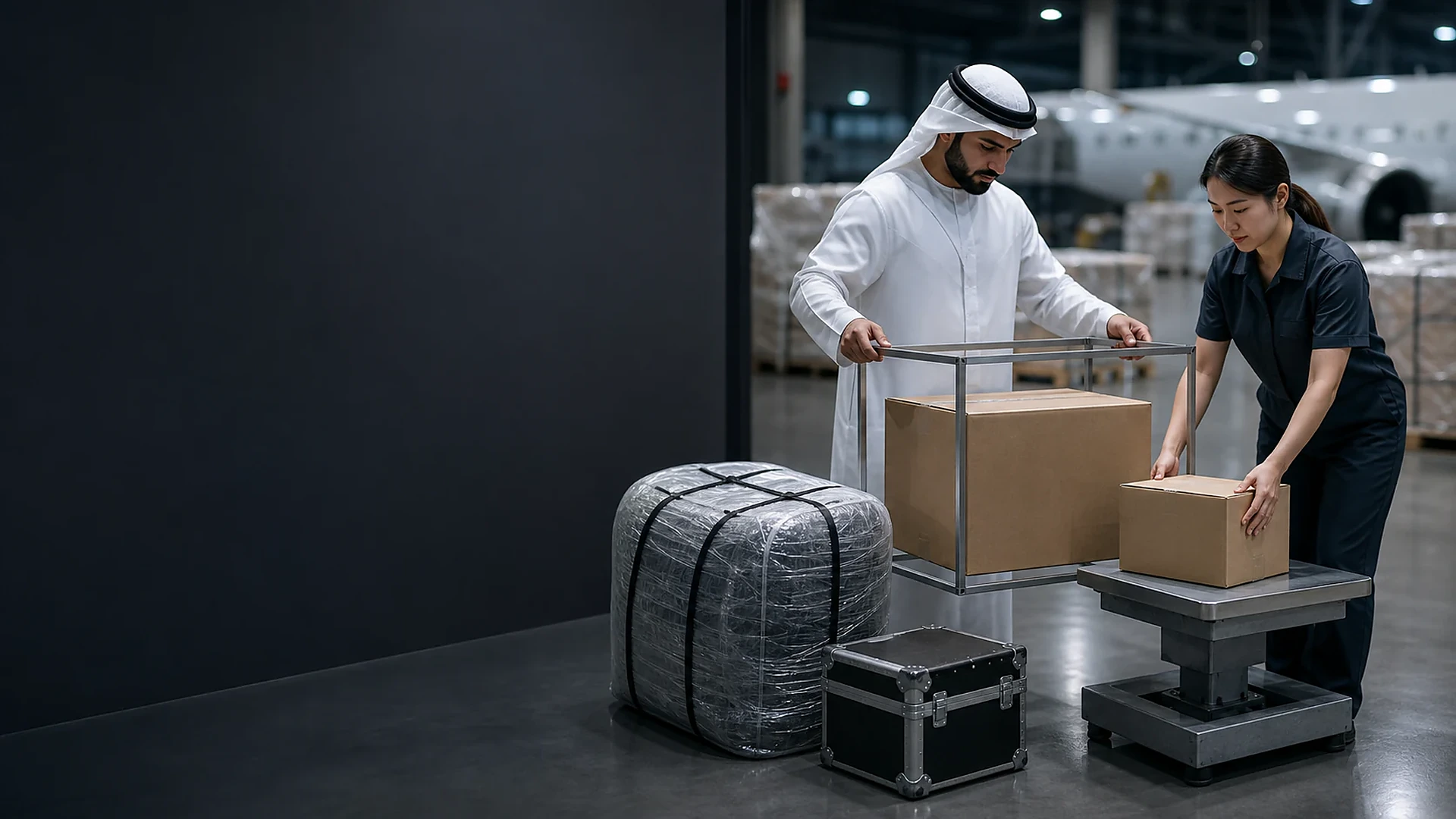
Cartons from multiple China suppliers consolidated at a warehouse before shipment Cartons from multiple China suppliers consolidated at a warehouse before shipment alternate workspace scene Cartons from multiple China suppliers consolidated at a warehouse before shipment detailed sourcing coordination scene
Logistics & Operations · Freight Basics

Freight Consolidation, Explained

Multi-supplier orders that ship separately pay for the same fixed freight costs three or four times over. Here's what consolidation actually is, how the warehouse step works, and when it's worth doing.

🚢

Any Incoterm, explained

FOB, CIF, DDP, and EXW broken down in plain terms, not legal jargon.

🧾

Tariffs estimated by HS code

Duty rates matched to your product's classification before you commit to an order.

🛡️

Verified before deposit

Supplier and factory checks coordinated before your money moves — not after.

📦

Shipped under your Incoterm

Any Incoterm, coordinated from factory to your destination port.

Page visuals

Visual checkpoints for Freight Consolidation , Explained

Additional realistic images have been added to support the page content while keeping the current LIFA layout and card styling.

Freight Consolidation , Explained - Shipment planning

Shipment planning

A practical view of the sourcing work behind this page.

Freight Consolidation , Explained - Carton review

Carton review

Details buyers can review before they compare supplier options.

Freight Consolidation , Explained - Freight comparison

Freight comparison

China-side coordination evidence organized for clearer decisions.

Freight Consolidation , Explained - Document check

Document check

Operational details that help reduce avoidable sourcing mistakes.

Freight Consolidation , Explained - Handoff prep

Handoff prep

Preparation notes for production, packing, or shipment follow-up.

Why multi-supplier orders waste freight cost

Freight consolidation is the practice of collecting goods from multiple suppliers at a single warehouse in China before they ship together as one combined shipment, under one set of documents — instead of each supplier's portion moving separately. It spreads the fixed costs of freight (handling, documentation, minimum charges) across the full combined volume instead of paying them once per supplier.

A buyer sourcing products from three different factories in three different cities, each shipping separately, pays for three partial containers or three separate LCL (less-than-container-load) bookings — each carrying its own minimum handling fee, its own documentation set, and its own risk of delay. The savings scale with how fragmented the order is: a buyer combining five small supplier shipments into one container typically sees meaningfully lower total freight cost than shipping each separately, even after accounting for the warehouse handling fee.

How consolidation actually works

  • Suppliers deliver to one warehouse. Each factory ships its portion of the order to a consolidation warehouse (often near a major port) instead of directly to the port themselves — this requires coordinating pickup timing across every supplier so goods arrive within a workable window of each other.
  • Goods are checked and combined. At the warehouse, cartons from each supplier can be counted, spot-checked, and repacked or re-palletized as needed before being loaded together as a single consolidated shipment.
  • One set of shipping documents. The consolidated shipment moves under a single bill of lading and commercial invoice covering the combined cargo, rather than separate paperwork per supplier — simpler customs clearance at destination.
  • Timing coordination is the real complexity. If one supplier's production runs late, it can hold up the entire consolidated shipment — buyers need either buffer time built in, or a policy for shipping the ready suppliers first and the late one separately.

Consolidation vs. LCL: two different things that get confused

"Consolidation" and "LCL" often get used interchangeably, but they answer different questions. LCL (less-than-container-load) describes how a shipment is booked with the ocean carrier — your cargo shares container space with other shippers' unrelated cargo. Consolidation describes how your own multi-supplier order is physically combined before it's ever booked with a carrier. A consolidated shipment can then move as LCL if it's still under a full container's worth, or as FCL (full container load) if the combined volume fills one. See the full LCL vs FCL comparison for how that booking decision is made once your cargo is combined.

When consolidation is worth it

Consolidation makes the most sense for buyers ordering from multiple suppliers per shipment cycle, and for orders too small individually to fill a full container but too large to ship efficiently as air freight. It's less useful for a buyer working with a single large-volume supplier who already fills a full container alone — in that case, there's nothing to consolidate with, and the added warehouse handling step is unnecessary cost.

Coordinating consolidation from the China side

The part of consolidation that's hardest to manage remotely is timing — knowing which suppliers are actually ready, catching a delay before it holds up everyone else, and confirming what arrives at the warehouse matches what each supplier promised. LIFA coordinates multi-supplier pickup timing, warehouse consolidation, and combined shipment documentation through shipping coordination, helping reduce duplicated freight costs across a fragmented order.

Going deeper: strategy, cost modeling, and red flags

This page covers the fundamentals. For a full cost-breakdown example, timing strategy across multiple suppliers, how to vet a consolidation provider, and the red flags that signal a warehouse or forwarder isn't managing consolidation well, see the companion guide: Freight Consolidation Strategies.

Multi-supplier cartons checked and combined at a China consolidation warehouse
LogisticsCartons from every supplier are counted and checked before combining.
TP

Open to Transparent Buyer Feedback

Trustpilot profile link
No invented ratings or review counts

LIFA Global Trade welcomes honest customer reviews on Trustpilot. Real feedback helps buyers evaluate our China sourcing support, communication, and coordination services with transparency.

Your honest feedback helps us improve our sourcing support and helps other buyers make informed decisions.

Buyer questions

Freight consolidation, answered simply.

The questions importers ask most about combining multi-supplier shipments.

Freight consolidation is the practice of combining goods from multiple suppliers at a single warehouse in China, so they ship together as one shipment under one set of documents instead of moving separately. It spreads the fixed costs of freight — handling, documentation, minimum charges — across the combined volume instead of paying them once per supplier.

They're related but not identical. LCL (less-than-container-load) describes how a shipment is booked with the carrier, sharing container space with other shippers' cargo. Consolidation describes how your own multi-supplier order is physically combined before booking. A consolidated shipment can then move as LCL or, if it's large enough, as a full container (FCL).

It's worth it for buyers ordering from multiple suppliers per shipment cycle, especially when each supplier's portion is individually too small to fill a container efficiently. It's less useful for a single large-volume supplier who already fills a full container alone — there's nothing to consolidate with, and the warehouse handling step adds unnecessary cost.

A late supplier can hold up the entire consolidated shipment, since the warehouse is usually waiting for every supplier's goods before combining and booking. Buyers typically handle this by building buffer time into the schedule, or by shipping the ready suppliers first and sending the late one separately rather than delaying everyone.

The consolidation warehouse or forwarder issues a single bill of lading and commercial invoice covering the combined cargo from all suppliers, rather than separate paperwork per supplier. That single document set is also what simplifies customs clearance at destination.

Coordinating pickup timing across multiple China suppliers for a consolidated shipment
LogisticsTiming coordination across suppliers is the hardest part to manage remotely.
Multiple suppliers, one shipment

Sourcing from more than one factory in China?

Send your supplier list and shipment timing. LIFA coordinates pickup, warehouse consolidation, and combined documentation so your multi-supplier order ships as one, not three.